
The mineral most people are quietly deficient in (and it's not vitamin D)
A note: everything shared here is for general education and is not intended as medical advice. We always recommend working with a qualified practitioner for anything specific to your health.
I have a question and I want with you to sit with it for a quick second.
Have you ever experienced any of the following: waking up wide awake at 3am, muscle cramps, a little bit of anxiety that never seems to go away, and digestion that seems to be well.. a little slow??
I used to think all of these were because of stress, or age (I am 31 now), or maybe just what my body does. And honestly, that could be a small part of it. But for a surprising number of people, there’s a something quieter lurking underneath. And it’s something that rarely makes headlines the way vitamin D does.
It’s magnesium.
“Nearly half of Americans don’t consume enough magnesium on a daily basis and many don’t connect their symptoms to it”
Why magnesium, and why now?
Magnesium is involved in over 300 enzymatic reactions in the human body. And no, I didn’t make a typo. Three hundred. It’s helps regulate everything from muscle and nerve function, to blood sugar and blood pressure, protein synthesis, and it even plays a role in sleep and stress response.
The NIH’s dietary data confirms that up to 48% of Americans don’t meet their recommended daily intake. In fact, a 2017 review published in the journal Nutrients by Schwalfenberg & Genuis documented the wide range of magnesium's role. They connected low magnesium intake to cardiovascular health, mood regulation, sleep quality, and bone density.
Magnesium, however, is one of those deficiencies that’s trick to confirm through standard blood work. Serum magnesium levels can appear normal even when total body stores are low because the body will pull from bone and tissue to maintain blood levels [Nutrition Reviews, 2012]. Some researchers would argue that this makes magnesium a bit of a blind spot. Other’s would say that serum tests are sufficient for most people. But the truth is that the research here is a little contested. (If you're concerned about your levels, this is worth raising directly with your doctor. They can discuss whether more comprehensive testing makes sense for you.)
What does low magnesium actually feel like?
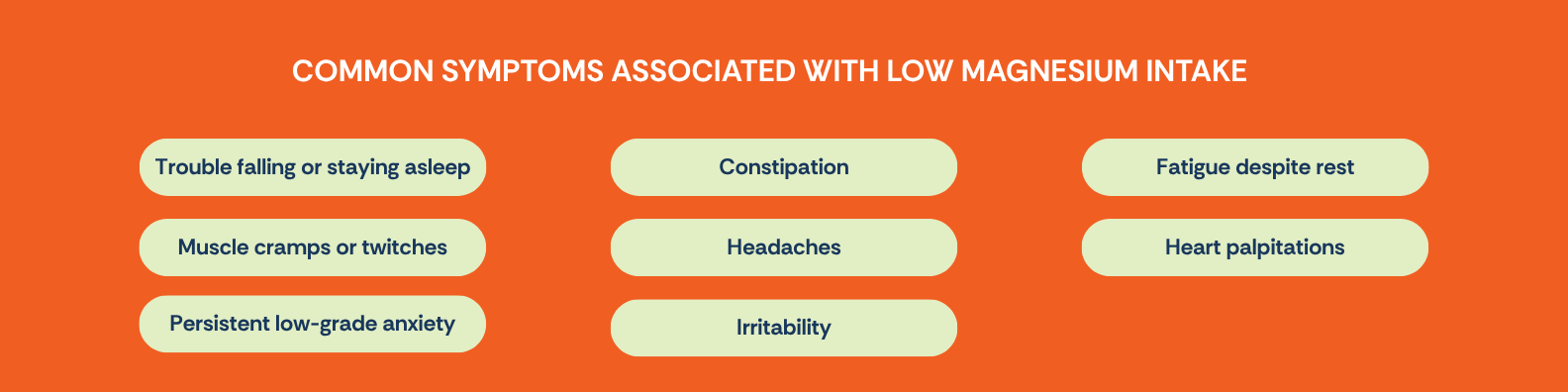
To talk about sleep specifically, magnesium helps regulate melatonin and activates the parasympathetic nervous system — our “rest and digest” state. Research published in the Journal of Research in Medical Sciences found that magnesium supplementation significantly improved sleep efficiency, sleep time, and early morning awakening in older adults with insomnia. [Journal of Research in Medical Sciences, 2012]
For anxiety, magnesium modulates the NMDA receptor and influences cortisol regulation. In a 2017 systemic review in Nutrients, they found consistent evidence linking low magnesium to higher levels of subjective anxiety. However, the authors state that these trials could be variable and more research is needed in this area. So why is that important? Because research shows a link but doesn’t point to supplementation fixing your anxiety.
So why can’t we just eat more of it?
Now this is where things get a little tricky. The truth is magnesium used to be a little easier to get from food sources. That was before agricultural practices striped a lot of it from our soils. Studies have shown measurable declines in magnesium content of common vegetables compared to crops grown in the mid-20th century. The food is there, but sadly the mineral content isn’t what it once was.
The good news? Whole Foods are still your best starting point to increasing magnesium. Here are some of the highest density sources:
Pumpkin seeds (pepitas) ~168mg/oz
Spinach (cooked) ~157mg/cup
Almonds ~80mg/oz
Dark chocolate (70%+) ~64mg/oz
Black beans ~120mg/cup
Edamame ~100mg/cup
The RDA for magnesium is 310-420mg per day, depending on age and sex. A handful of pumpkin seeds and a big leafy salad gets you pretty close, especially if you’re eating them consistently.
A note before you go shopping for supplements: this post is informational, not medical advice. If you're experiencing persistent symptoms, the right first step is a conversation with your doctor — not a product in your cart. The evidence around dietary magnesium is solid; the evidence around supplementation is more nuanced, and individual needs vary.
Free: High-Magnesium Foods Cheat Sheet
A simple, practical breakdown of the top food sources of magnesium — seeds, leafy greens, legumes, whole grains, and a few that might surprise you. Serving sizes and daily targets included so you know exactly what you're working toward.
SOURCES
1. National Institutes of Health (NIH) Office of Dietary Supplements. Magnesium Fact Sheet for Health Professionals. ods.od.nih.gov
2. Schwalfenberg GK, Genuis SJ. "The Importance of Magnesium in Clinical Healthcare." Nutrients. 2017;9(9):1158. doi:10.3390/nu9091158
3. Abbasi B et al. "The effect of magnesium supplementation on primary insomnia in elderly." J Res Med Sci. 2012;17(12):1161–1169.
4. Boyle NB, Lawton C, Dye L. "The Effects of Magnesium Supplementation on Subjective Anxiety and Stress." Nutrients. 2017;9(5):429.
5. Rosanoff A, Weaver CM, Rude RK. "Suboptimal magnesium status in the United States: are the health consequences underestimated?" Nutrition Reviews. 2012;70(3):153–164.
6. Rude RK. "Magnesium deficiency: a cause of heterogeneous disease in humans." J Bone Miner Res. 1998;13(4):749–758.
7. USDA FoodData Central. fdc.nal.usda.gov
8. Davis DR, Epp MD, Riordan HD. "Changes in USDA Food Composition Data for 43 Garden Crops, 1950 to 1999." J Am Coll Nutr. 2004;23(6):669–682.